From a first, awkward C chord to a lifetime of fingerstyle playing, distinctive guitars, musical friendships, ragtime, country blues, shared arrangements, club weekends and recordings.
FingerstyleCountry bluesRagtimeFolk
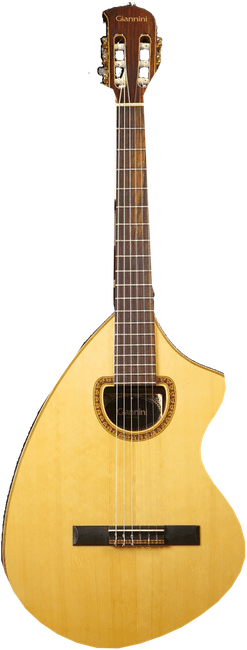
Giannini Craviola · Steve's own, circa 1974
The first encounter · 1968
A guitar looked a rather unlikely proposition
My musical interests really began in 1968, when I began going out with Marise Clewes, who lived in Runcorn. I had met Marise while working at the Pathology Laboratory in Whiston Hospital, Liverpool. She played guitar — strummed rather than fingerpicked — and sang at church and at house meetings.
During that period she took a couple of photographs of me holding her guitar, with the fingers of my left hand arranged in a C chord. I was amazed that anyone could do this for enjoyment. It looked awkward and, to my inexperienced fingers, distinctly painful. Little did I know!
That first encounter did not mean I immediately became a guitarist. The actual start came some years later: I have described myself on the Guitar Pages as having played acoustic guitar, on and off, since 1974.
The first instruments
The Craviola, then a Yamaha · from circa 1974
The Giannini chapter
An unusual shape — and a welcome bass response
When I finally decided to take up an instrument, the choice came down to drums or guitar. I was living in an end-terrace in Main Street, Halton, with neighbours close by, so the quieter instrument had an obvious advantage. I also fancied melodies more than rhythms — and, at the time, wrongly assumed that drums could not be a solo instrument.
I went to Dawson's Music Shop in Chester and tried the guitars on display. I had little idea what I was looking for, but settled on a nylon-strung Giannini with a very unusual outline. I later learned that the model was called a Craviola. I acquired mine around 1974. The photograph shown here is of an identical Craviola supplied from 1978; it is a reference image of the same model, not a suggestion that my own guitar was bought in 1978. The nylon strings were kinder to my fingers than the steel-strung guitars I tried, and I loved its bass response.
A few months later I returned to the search for a steel-strung guitar. After nearly surrendering my left-hand fingers to a large-bodied Giannini with very heavy strings, I eventually chose a Yamaha FG180. That guitar stayed in the family; my brother Paul owns it now.
Giannini Craviola · circa 1974Yamaha FG180 · a few months laterPlaying acoustic guitar since 1974
The guitars I reach for now
Three very different voices · plus a few more
The Craviola and Yamaha belong to the early part of the story. The instruments I mainly play now have each arrived at a different stage of that journey: a handmade Dinsdale with a personal history, a Japanese K. Yairi OM, and a compact Martin with a vintage-inspired design. I still have other guitars too, including further Dinsdales.
British handmade · circa 1982
Bill Dinsdale Jazz Cutaway
This is a particularly personal instrument. Bill originally built it for himself, but hard financial times meant that he had to sell it through Sounds Acoustic in Manchester. It eventually became one of my principal guitars.
Because Dinsdale made individual instruments rather than a mass-produced catalogue line, I have not found a reliable published specification for this particular Jazz Cutaway. I would rather describe its known history than guess at its woods, dimensions or bracing.
This is an orchestra-model (OM) acoustic, hand-built in the Kani workshop in Gifu Prefecture, central Honshu, Japan. The FY-84 combines a solid Sitka spruce top with rosewood back and sides. Its round soundhole has an abalone-shell rosette, and the body has multi-layer, ivory-coloured binding and a natural gloss finish.
The neck is hand-carved mahogany with a U-shaped profile. The ebony fingerboard carries pearl-dot and cat's-eye inlays, while the ebony Direct Coupled Bridge (DCB) is one of Yairi's distinctive design features. The instrument is particularly well suited to fingerpicking, with clear note definition, while also accommodating light-to-moderate strumming.
The Direct Coupled Bridge: this is a Yairi split/separate bridge design, not simply a conventional bridge with the strings fed straight through the soundboard. Yairi describes it as an original bridge with a distinctive tension design and improved note separation. Alvarez's technical explanation says the arrangement couples string vibration more efficiently to the top, redirects string tension downwards, increases volume and projection, and helps reduce bridge lift and soundboard distortion.
The CEO-7 is a compact 00, 14-fret slope-shoulder model. Martin's published specification lists an Adirondack spruce top, mahogany back and sides, scalloped X-bracing, ebony fingerboard and bridge, a modified-V neck, 24.9-inch scale and 1¾-inch nut width.
Its short scale and small-bodied outline make it a distinctive member of my current group of main guitars.
Friends, guitar shops and the sound of fingerstyle
From the mid-1970s · Tuesdays
Kieran 'Fish' Carr
Kieran was the first person I regularly played guitar with. He came round every Tuesday evening: we'd get the guitars out, try tunes and duets, natter about music and life, then often go out for a pint. We also went to the occasional acoustic-guitar concert together. Those evenings became the bedrock of my early playing.
Manchester · around 1977
Mike Martin joins the circle
Kieran and I met Mike Martin through the Manchester guitar scene. Mike was already a remarkable player: his playing made a lasting impression on me, and he became a constant part of the group and the wider Tape 'n' Tab story. The surviving T'n'T archive even records Mike and Kieran playing M&O Blues and Canned Heat in 1977 — a lovely snapshot of the music-making that was already under way before the club was formally established.
Manchester · Sounds Acoustic
Four hours — and a Dinsdale
Kieran and I once found the new Sounds Acoustic shop closed. The owner of the neighbouring drum shop had a key and offered to let us in. Nearly four hours later, after playing Martins, Gibsons, Epiphones, Fyldes and many others, the small-bodied Dinsdale 00 had made the strongest impression.
The missing Dinsdale 00, number 001
Kieran chose the 000 and I chose the 00. Mine was stamped number 001. I later returned it to Bill while we worked on a new fingerboard design; it was stolen from his workshop during that time. This is the earlier 00 — quite separate from the Dinsdale Jazz Cutaway I own now. If number 001 ever turns up, I would very much like to know where it is.
♪
The music that took hold
A solo guitar can be a small band in its own right
My strongest interests settled around acoustic fingerstyle: music in which the thumb keeps the bass moving while the fingers carry chords, syncopation and melody. Country blues and ragtime became particular favourites, with folk and traditional tunes widening the repertoire.
The blues
Country blues
The playing of Mississippi John Hurt, Blind Blake, Blind Boy Fuller and the Reverend Gary Davis became part of the musical landscape — intricate, rhythmic guitar music that can sound like several parts being played at once.
The syncopated side
Ragtime
Ragtime fingerstyle brought a different challenge: maintaining a steady bass while placing a syncopated melody above it. The music of Scott Joplin, James Scott and other ragtime composers found its way into my arrangements.
Beyond the blues
Folk & traditional tunes
Jigs, reels, hornpipes, songs and older popular tunes provided another strand. I have always enjoyed finding ways to make very different kinds of music work on a single acoustic guitar.
Rolling Susan · 1979Epaise BluesCollege RambleCalliope RagWeeping WillowSunflower Slow DragTruckin' Little Baby
The examples include original compositions, collaborative pieces and arrangements or transcriptions. The full credits are retained with the individual scores in the Guitar Pages archive. The archive is not just a list of tabs: it records the music that grew out of the playing friendships, T'n'T weekends and the work of sharing arrangements by hand, cassette and later TablEdit.
Playing duets with Kieran
Kieran 'Fish' Carr and I developed our own duets and also worked on pieces inspired by recordings from Lasse Johanssen and Claes Palmquist on Stefan Grossman's Kicking Mule label. Sharing the work — learning both parts, arranging and then playing together — was a big part of those years.
Along the way we met and heard many remarkable guitarists, including Stefan Grossman, John James, Martin Simpson, Woody Mann, Laurence Juber, Duck Baker and Ralph McTell. Those encounters, records and friendships all fed the enthusiasm.
Tape 'n' Tab Club — T'n'T
Formed in Runcorn in 1978
Playing, writing, recording and friendship
From a few guitar-playing friends to a club spread across the country
The roots of Tape 'n' Tab were friendship as much as music. Kieran 'Fish' Carr was my first regular guitar-playing companion; the Tuesday evenings at my house — playing, trying duets, chatting and then heading for a pint — had already given us a shared enthusiasm. We also attended occasional acoustic-guitar concerts together.
In around 1977 Kieran and I met Mike Martin through the Manchester guitar scene. Mike's playing was extraordinary to my ears, with a fluency, fire and passion that made a strong impression. He was there at the start when I began drawing players together, and he has remained part of the group ever since. The early circle of Kieran, Mike and myself became the seed from which the wider Tape 'n' Tab Club grew.
After visiting Clancy's guitar evenings in Manchester with Kieran and Mike, I wanted to bring more players together to share tunes, arrangements, compositions, techniques, tablature and recordings. The Tape 'n' Tab Club was formed in Runcorn in 1978 and had become firmly established by early 1981.
We held around four or five long weekends each year. People arrived on Friday and stayed until Sunday. There was a great deal of guitar playing, tunes being passed around, informal performances and, on Sunday morning, serious recording. We exchanged handwritten tablature and cassette tapes, and recorded many of the weekend's pieces on a reel-to-reel tape recorder. The combination of a written tab and a recording meant that a tune could travel home with a member and be learned before the next meeting.
Players came from the North West and much further afield. Alongside Kieran and Mike Martin, those associated with the club included Alan Hooper, Dick Wildman, Chris Cassidy, Ian Jesse, Joe Cainen, Andy Gibson, Bill Dinsdale and many others. The club's most intense early period gradually wound down around 1984–85 as people moved, married, had families and followed their working lives.
Share tunes & arrangementsLearn from one anotherRecord and keep the music
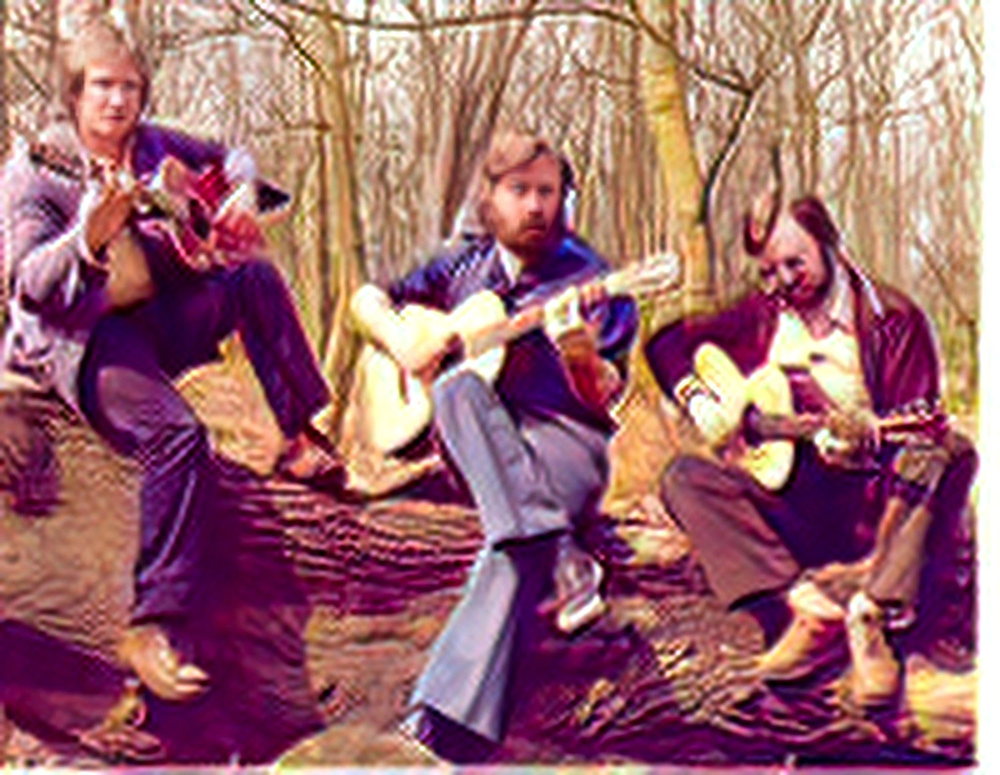
Mike Martin, Steve and Kieran 'Fish' Carr in Halton Wood in the 1980s — three of the people at the heart of the T'n'T story.
Nobody's Business — with Ian Jesse
A guitar and a multi-instrumentalist
Late 1980s to 2000
Two musicians, several instruments and a varied repertoire
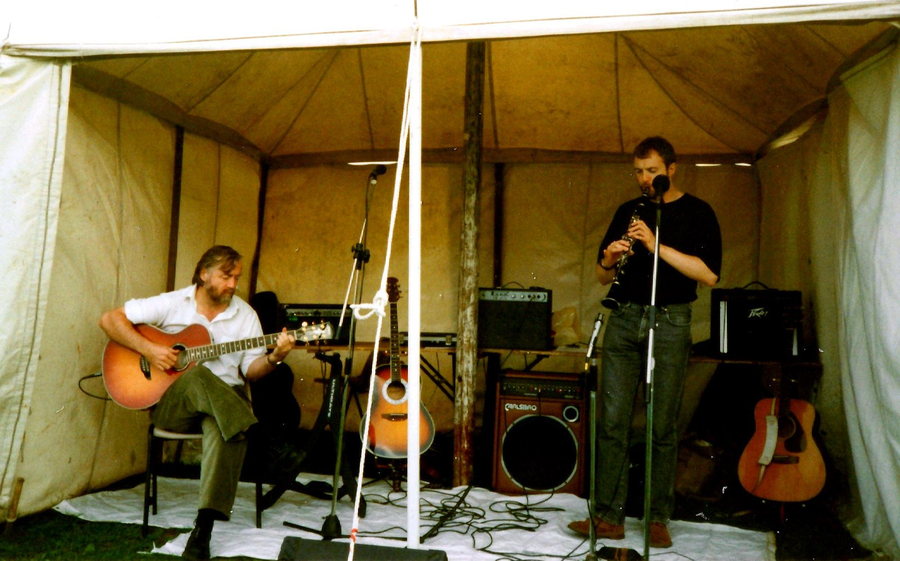
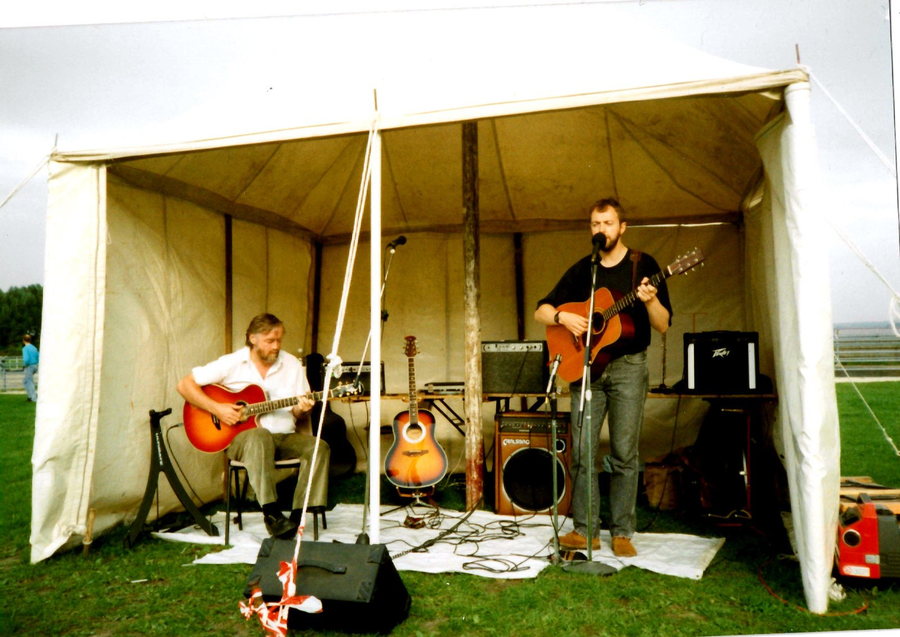
In the late 1980s I teamed up with Ian Jesse, an excellent singer and multi-instrumentalist. I played the six-string guitar, drawing particularly on fingerstyle country blues and ragtime. Ian could sing, play guitar, clarinet, flute, whistle, mandolin and keyboard. His changes of instrument gave the music a much wider colour than a conventional guitar duo.
Our repertoire included country blues, ragtime, folk, contemporary material and a little light rock. We played at music weekends at Dehon House on the Wirral and Savio House in Bollington, at folk clubs around the North West, at a school in Blackpool and at a tucked-away pub in Chelmorton, Derbyshire. The latter could mean playing until three or four in the morning. The duo eventually disbanded in 2000.
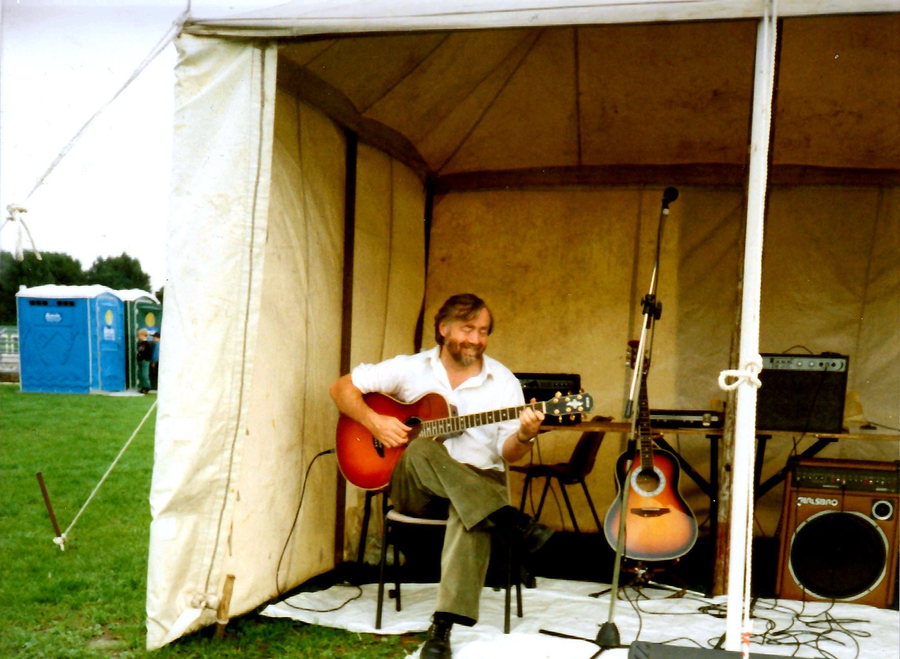
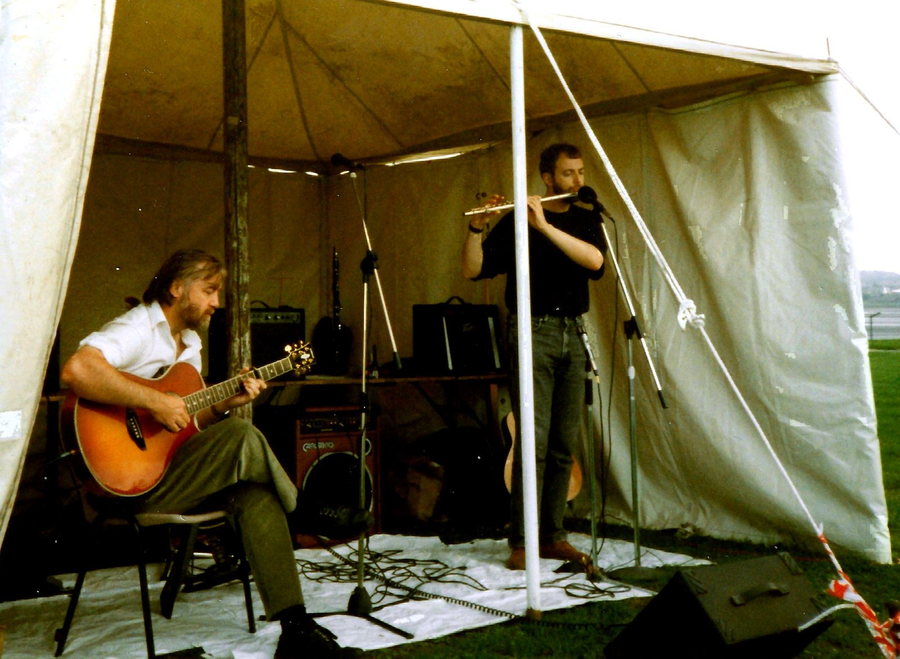
These photographs record Sailing the Sankey at Spike Island, Widnes, on 17 September 1995. The original colour prints had aged and carried a pronounced warm cast; the web versions here have had restrained colour-balance, tonal and sharpening work while retaining their documentary character.
Steve playing solo.Guitar with Ian on flute.Guitar with Ian on clarinet.Both on acoustic guitar.
From 1996 to 2000 I taught adult students, mainly in evening classes at Halewood Comprehensive. It was satisfying to see people begin the year unsure even how to hold the guitar and finish able to play substantial pieces.
The material included country blues by Mississippi John Hurt, Blind Blake, Blind Boy Fuller and the Reverend Gary Davis, alongside folk, jazz, ragtime and popular music from the 1930s, 1940s and 1950s — with the occasional piece of rock thrown in. I had also studied Trinity College music theory at Chester College in 1986–87, completing Grades 1 to 5 with distinctions.
One of the students, Phil Lawton, later took over the class and helped establish a guitar club in Gateacre. That club has since ceased meeting, but it was a pleasing continuation of the idea that players improve by sharing music and helping one another.
The music is still being shared
Old tapes, new performances and tablature videos
The present-day archive
T'n'T has changed its format, but not its purpose
Although the original long-weekend gatherings belong to the past, many of the friendships continued. Since 2021, some former members and newer players have met online each month to talk guitars and equipment, demonstrate music-related software and hardware, share arrangements and compositions, and play tunes to one another. It is a modern version of the same old idea: exchange music, learn from each other and keep in touch.
The musical record now has two complementary YouTube homes. Tape 'n' Tab Club Tracks shares performances from the old cassette and reel-to-reel archive, together with newer playing by club members. Tape 'n' Tab Club Tabs shows TablEdit tablatures being played back in video form, so listeners can follow the music and see how the arrangements are laid out.
The archive includes original pieces such as Rolling Susan (1979) and Epaise Blues, collaborative work such as College Ramble, and arrangements ranging from ragtime and country blues to traditional jigs, reels and popular tunes.
Explore the wider guitar archive
The detail, the people and the tunes
This page is the personal account. The Guitar Pages hold the fuller record of the players, instruments, music weekends, styles, arrangements and downloadable tablature.
I have also spent many years building and maintaining the Guitar Pages website as a practical home for that material. It brings together my tablature, arrangements, duet parts, MIDI files, information about players and makers, and resources for other guitarists. More recently I have been developing a browser-based practice player for TablEdit files, with the aim of keeping the displayed score in step with the music as it follows repeats and the written playing order.