Moths & butterflies
Lepidoptera, from light-trapping and larval searches to habitat-based recording and county distribution work.
Field notes · observation · recording
A lifetime spent looking more closely — from the moths and caterpillars of childhood to the much wider biodiversity of Britain and Ireland.
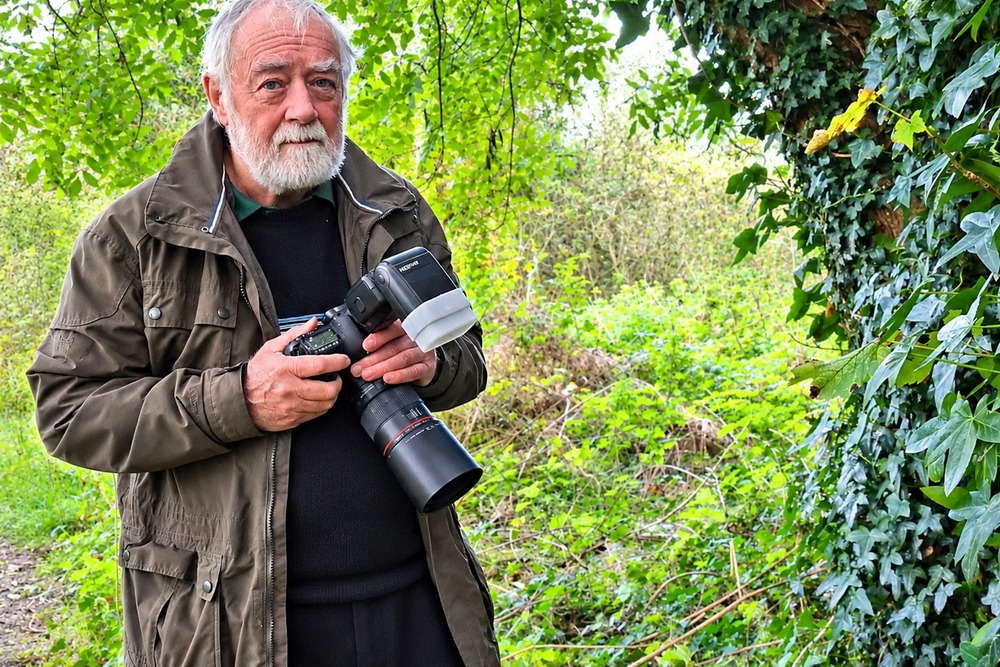
The naturalist's notebook
My interest in natural history has been with me for as long as I can remember. Invertebrates have usually held the strongest fascination, but the pleasure is in looking carefully at whatever is there: a moth at the trap, a leaf mine, a gall on an oak, a bird overhead, or a tiny creature that most people would walk straight past.
Over the years that curiosity has developed into field observation, photography, specimen examination, identification, recording and the sharing of records so that they can be used by other naturalists and by conservation projects.
Where it began
The beginning was not a grand expedition. It was curiosity, a classroom display and the excitement of watching caterpillars become moths.
At Lambshear Lane Primary School in Maghull, my interest in natural history was encouraged when I was put in charge of the nature table in Mrs McMahon’s class. Part of the job was keeping the exhibits in order and looking for seasonal subjects to add to the display.
The memory that stayed with me was a class project breeding Yellow-Tail Moth caterpillars. The caterpillars were fascinating in themselves, but the following year the moths emerged — an event that made a lasting impression. It was an early lesson that there was a great deal of life happening in the ordinary places around us, provided we took the trouble to look.
The centre of gravity
Entomology remains a strong thread, but the recording interest has broadened well beyond insects.
Lepidoptera, from light-trapping and larval searches to habitat-based recording and county distribution work.
Symphyta and their hosts, life histories and identification — including county recorder work in Cheshire.
Coleoptera and Hemiptera, including galls, leaf-miners, scale insects and less conspicuous groups.
Diptera and the value of building, checking and joining up records gathered by many recorders.
Hymenoptera, including aculeates and parasitoids — groups where reliable identification and good records matter.
Mites, springtails, millipedes, centipedes, woodlice, lacewings, caddisflies and many more.
Vascular plants, bryophytes, lichens and micro-fungi — increasingly part of the wider natural-history picture.
Mammals, molluscs, birds and other vertebrates all have a place in a genuinely broad recording habit.
County recording
Recording is not simply making a list. It is building a picture of where species occur, when they are present and what habitats they depend upon.
I became Cheshire's County Macro-moth Recorder in early 1998. The work involved bringing together records from a wide range of observers, improving their precision and making the information useful for distribution mapping. A particular concern was to move beyond broad 10-kilometre squares wherever possible and work towards reliable six-figure Ordnance Survey grid references.
The old Cheshire moth archive preserves reports spanning 1976 to 2000, together with papers on recording in specialised habitats, moths associated with heather and reed-beds, species tied to particular foodplants, and the practical business of improving coverage.
One example in that archive is the attention given to reed-beds at Moore Nature Reserve near Warrington. A paper by C. Ian Rutherford records that the targeted moth-trapping work there added two species to the Cheshire county list. It is a good illustration of why going to the right habitat can matter more than simply running another trap in a garden.
My own moth recording has continued alongside the county work. I bought two Watkins & Doncaster Robinson traps in 1984, and they have remained part of my equipment ever since. I normally run them with a 125-watt mercury-vapour bulb.
At my garden at Hunters Chase, the accumulated moth records reached 1,073 observations representing 168 species by August 2026. Those figures are a dated snapshot rather than a permanent total. Among the notable records was Catocala sponsa, which I recorded as a new Lancashire record.

Independent fieldwork
Alongside county recording and voluntary natural-history work, I also spent several years working independently in the field through my own consultancy.
From 1995, I operated Consult-Eco as my own independent consultancy. An important part of that work was freelance biodiversity and invertebrate surveying: visiting sites, finding and identifying species, compiling records and preparing information that could contribute to a better understanding of their wildlife.
The survey work drew on my particular experience with moths and butterflies, sawflies, aculeate Hymenoptera, ground beetles and hoverflies. Consult-Eco also undertook education and training, but it was the practical fieldwork — discovering what lived at a site and documenting it properly — that connected the consultancy directly with my natural-history interests.
Examples of projects recorded in my CV include:
These are selected examples, rather than a complete list of consultancy assignments. Earlier survey and recording work, including work before Consult-Eco was established, is part of the wider history too.
From field notes to shared evidence
Individual observations become much more powerful when they are brought together, checked, mapped and made available to others.
A few records with a story
New-to-area records are not the only worthwhile ones, but they can show how careful observation adds detail to the regional picture.
A visit with Susan Marley to Stanley Park, Liverpool, for the Greenspace Challenge led to the discovery of scale insects on Evergreen Spindle. Follow-up recording at Newsham Park found the species again. The account discusses how the observations fitted the then-known local and national distribution.
When Louise Mills photographed this beetle at the National Trust’s Formby site, I identified it as Thanasimus formicarius; Don Stenhouse at Bolton Museum then confirmed the identification. Louise’s sightings were the first reported locally for 27 years. This was an identification contribution, not a claim that I found the beetle.
An adult taken at a garden light-trap provided the first confirmed record for South Lancashire (VC59). The identification was confirmed by Steve Palmer. The regional note is careful to distinguish this from earlier larval records, which had to be withdrawn after a similar leaf-mining species was recognised.
Found during a BioBlitz at Croxteth Park. The North West Invertebrates notes describe the gall as new to vice-county 59 and the region at the time, with only a small number of records then present on the NBN Atlas.
A mite gall-causer on Common Reed, recorded at Burton Mere on the Wirral. The regional notes described it as apparently new to VC58 and the wider region at the time of publication.
Steve is listed as a co-author, with Adrian Wander, Steve Hind and Kevin McCabe, of the 2002 note on Beautiful Hook-tip Laspeyria flexula and Dingy Footman Eilema griseola being new to Cheshire.
Recording across Britain and Ireland
The current work combines field observations with identification help and the quiet, continuing maintenance of shared taxonomic and geographic resources.
My iNaturalist work is not limited to uploading observations and identifying other people’s records. A substantial part of it is the design, construction and continuing curation of a connected suite of taxonomic, geographic, national, regional and site-based projects for Britain, Ireland and their associated islands. The examples below show the architecture and reach of that work; the profile links to the complete live project list. The profile currently shows more than 180,000 observations, 4,600 species and 470,000 identifications; those figures are live and continue to change.
The Natural History of Britain & Ireland Taxonomic Index is a human-curated, stable directory of taxon-based iNaturalist projects. It maps the hierarchy from the broad divisions of life down through kingdom, phylum, class, order and family, linking the broad all-wildlife level to specialist group projects. This includes invertebrates and vertebrate groups such as birds, mammals, fish, amphibians and reptiles, with further projects available through the index.
The companion Geographic Framework organises projects at several nested scales: vice-counties, countries and regions, Local Environmental Records Centre areas, local authority and community areas, and individual sites. It gives users a practical route from national coverage to a particular park, reserve, churchyard, cemetery or other greenspace. The linked projects include national vice-county coverage, regional recording-centre partnerships and directories of local places.
Local projects connect iNaturalist observations with the geography of the recording community and its Local Environmental Records Centres.
Additional umbrella projects make it easier to browse observations at country and broad organism-group level.
An important distinction: these projects are principally navigational and organisational frameworks. The Taxonomic Index is not a vetted UK species checklist and does not itself verify identifications. The Geographic Framework brings together established vice-county boundaries and locally drawn site or regional project areas; it does not replace formal recording schemes or define official administrative boundaries. Its value is in helping observers, identifiers and recorders find the right taxonomic or geographic context for observations.
View my iNaturalist profile and the complete list of projects I manage.
The wider local recording network
Merseyside BioBank’s newsletters and monthly wildlife notes provide a valuable running record of discoveries made by the wider naturalist community. Reviewing these alongside specialist regional follow-up accounts brings out records ranging from new localities to firsts for South Lancashire, the Northwest and Britain. The examples below are deliberately credited to the people who made or reported them.
These examples help place individual observations in the context of wider recording across the Sefton Coast and vice-county 59 (South Lancashire). They are not being claimed as my own discoveries.
Natural England’s Natalie Hunt discovered this rare liverwort in a newly created wetland at Hillside Golf Club. Merseyside BioBank’s January 2022 notes reported it as new to Sefton; a follow-up visit counted more than 200 specimens.
Merseyside BioBank reported Dr Phil Smith’s 28 August record as the first for the Sefton Coast and South Lancashire (VC59). It marked a notable westward shift from the species’ previously recognised south- and east-coast distribution.
Pete Kinsella photographed this hoverfly at Ainsdale on 2 July. Dr Phil Smith’s July 2023 notes described it as new to the Sefton Coast, adding another species to the coast’s invertebrate record.
Ron Moyes and Colin Daly light-trapped this micro-moth at Ainsdale on 15 November. Dr Phil Smith’s Merseyside BioBank wildlife notes described it as the first Lancashire record.
In his May 2024 wildlife notes, Dr Phil Smith described a photographed fly as apparently the first record for Sefton. It is a useful example of the regional value of recording less familiar Diptera as well as the more conspicuous groups.
During a Tanyptera recording day on 23 May, Phil Brighton collected this fly among 74 species found during four hours of sweep-netting. Subsequent microscopic examination established the first British record. Merseyside BioBank’s May 2025 notes flagged the discovery; the specialist account provides the identification and details.
North West Invertebrates: first British record · MBB May 2025 notes.
Both dragonflies were reported as new to the Sefton Coast during the May 2026 heatwave. The Merseyside BioBank notes describe the Norfolk Hawker sighting at Marine Gardens as probably the first for the coast; the specialist follow-up account identifies both species as new coastal records.
North West Invertebrates: 2026 southern arrivals · MBB May 2026 notes.
Dr Phil Smith found this southern soldierfly on 29 May. Merseyside BioBank’s May notes reported no previous Northwest sightings; a later specialist account confirmed the regional significance of the Ainsdale record.
North West Invertebrates: Ainsdale record · MBB May 2026 notes.
Dr Phil Smith recorded this mainly southern weevil during a Tanyptera field meeting on 24 July. His Merseyside BioBank notes described it cautiously as a likely first for the Sefton Coast; it is therefore presented here as a provisional regional first.
Encouraging younger naturalists
A youth initiative within the Lancashire & Cheshire Entomological Society, bringing younger enthusiasts into contact with experienced naturalists and the Museum’s Entomology Section.
During my involvement with the Lancashire & Cheshire Entomological Society (LCES), I established The Underwings, a subsidiary society for young people aged between seven and fifteen who had an interest in entomology and, more broadly, the natural world. The aim was to give younger enthusiasts an opportunity to develop their interests and to encourage a new generation of naturalists.
The Underwings met at Liverpool Museum, where staff from the Entomology Section were involved in the meetings — probably all of them at some point. This gave the youngsters access to people with specialist knowledge and experience, as well as an environment closely connected with the subject that interested them.
At first, not all the older members of the LCES were convinced that a young people's group should become involved in the Society's activities. When I proposed bringing The Underwings to the annual exhibition meeting, the Conversazione, held at the Swimming Baths and Leisure Centre in Woolston, Warrington, several members voiced concerns.
The first Conversazione attended by the youngsters changed that. They brought their collections and projects, talked about their work and discussed entomology with the older members. They made it clear that, despite their age, they were just as serious about their interests as the established entomologists. The LCES members were won over. The Underwings were subsequently welcomed at Society meetings and Museum training meetings, and a number of members became more involved with supporting the younger naturalists.
It was a positive development: the youngsters gained encouragement and access to experience, while the Society had an opportunity to engage with the next generation. The Underwings helped bring the generations together rather than keeping young enthusiasts on the margins.
Eventually, a change in Museum management brought the use of the Museum's 'horseshoe' area, where the Entomology collections were housed, to an end. This removed the regular meeting place for The Underwings and also meant that the LCES itself had to find somewhere else to meet. The Society moved to Frodsham Community Centre, but the cost of the venue and the fact that meetings were held at night made it unsuitable for the younger group.
The Underwings therefore moved for a time to the Visitor Centre on Spike Island in Widnes, where it continued for a year or two. Eventually it faded away. I cannot say whether this was mainly a consequence of losing the Museum facilities and the involvement of its staff, or whether the group had simply run its course. Whatever the reason, it had already achieved something worthwhile: young people had been given the opportunity to develop their entomological interests, share their work and be recognised as serious contributors to the natural history community.
Selected reading & record archives
These links lead to records, reports and independent accounts that document parts of the work. They are not all authored by Steve; where a contribution is acknowledged rather than an authorship credit, that distinction is stated.