|
[Home] --
[T'n'T] -- [Players in NW] --
[Tunings] -- [My Tabs] --
[Friends' Tabs] -- [Other Guitarists' Tabs] --
[Duet Tabs]
Many of the tunes on this site can be seen playing in TablEdit on YouTube at: Various Open & Altered Tunings For Guitar (Including Alternative Tunings)
[Home] -- [T'n'T] -- [Players in NW] -- [Tunings] -- [My Tabs] -- [Friends' Tabs] -- [Other Guitarists' Tabs] -- [Duet Tabs] 1. Most Used Tunings ? - The most commonly used tunings are the first three in the list, Standard Tuning, Dropped 'D' Tuning (or Low D Tuning) and Dropped 'G' Tuning (occasionally called Double Dropped D Tuning). Following this the major 'favourites' seem to be Open 'G' Tuning, Open 'D' Tuning, Open 'C' Tuning and DADGAD Tuning. Some players use only one of the others and do not experiment any further. Some players, notably Classical guitar players, stick solely with Standard Tuning. However, by far the majority of players use a small few for most of their playing and occasionally experiment with something a little more outlandish. The main point is to try a couple; see if you can get along with them and if they can enhance your music; most of all have FUN with them. 2. Hi-Note or Hi-String Tuning: - (also known as Nashville Tuning) uses the notes EADGBE which looks as though it is the same as Standard Tuning. Do not be fooled, it is not the same! The reason is that the bass strings are removed from the guitar and are replaced with another set of treble strings which are then tuned to the relative notes. Consequently a much higher sound is produced which has a greater tendency to cut through when other instruments are being played as part of a band. Be careful however, as not all finger-picked tunes which sound well on a normally strung guitar will sound well with this string arrangement; some do and some don't - you'll have to try them and make the decision yourself. The tuning is most often used in 'Country & Western' music but it does have other possibilities, which need investigating, for both solo/instrumental work and also for providing a contrasting backing accompaniment for a low pitched singing voice. This restringing of a guitar and replacing one or more bass strings with higher, thinner treble strings is called re-entrant stringing and nearly all of the tunings in the above table can be applied when they will be called re-entrant tunings as the bass strings will now be higher than some of the mid/treble strings. Nashville tuning is a little more involved than just tuning your guitar differently. It's also known as high-stringing a guitar because different strings need to be used. It creates a 12 string effect on a 6 string guitar. The simplest way to explain it is, you use the high octave strings of a 12 string set of strings on a six-string guitar. The first two strings of your instrument (high E and B) remain unchanged, and the lower four strings (G through low E) are tuned an octave above standard tuning. It is possible to buy ready-made string sets for Nashville tuning but they may be hard to find. You can use a 12-string set (just use the octave or thin strings) but that's kind of expensive. The best way for you may be to buy the strings individually from your local music store's single-string bin. The gauges for a medium set would be .012, .016, .010,
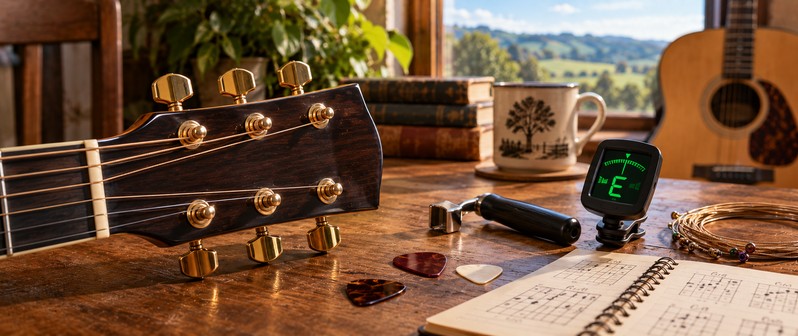
.014, .020, .030 high to low. How to get into Nashville Tuning: - Here's how you do it :- Leave the high E and B strings alone, they stay the same. Use a 009 or 010 as a G string and tune it up to G, the same G you hear on the 3rd fret of the high E string. Use a 012 as a D string and tune it to D, the same D as you hear on the 3rd fret of the B string, Use a 016 as A string. Tune it relative to the D string. Use a 024 wound string as a bottom E. Tune it relative to the A. Now you have a guitar that's tuned EADGBE as normal, but you'll hear all kinds of nice doubling up of notes emerging. The hardest part is convincing your fingers that you can still play as normal, especially when you hit that really high G string. 3. Tuning Your Guitar: - When this page was originally written (2001), the most accurate method of tuning available was via one of the portable battery operated tuning machines distributed by companies such as Boss, Sony, Yamaha, etc. All of the better models have a jack-socket input so that they can be placed between the guitar and the amplifier for electric and electro-acoustic guitars. This has made tuning on stage very simple and direct and is not troubled by sounds from other instruments in the band or from people in the audience. A new idea has recently appeared for those with purely acoustic (i.e. un-amplified guitars) and this is a small clip-on microphone which clips to the edge of the sound-hole of the guitar, or even to the headstock, and then plugs into the jack-socket of the tuner. Again, this is said to allow an acoustic guitar to be tuned accurately even while other people are playing and/or singing - this is a definite advantage as trying to tune a guitar by ear in a room full of people playing is something I find impossible - I normally have to go and tune in the loo. Some people find they can tune by ear in a noisy environment by placing the ear against the side of the guitar, not for me I'm afraid. Give me a decent tuner any day of the week! By 2008, a newer form of electronic tuner had appeared, this was/is the 'vibration' or 'headstock'
tuner. It clips to the headstock of your instrument and instead of having a
microphone it picks up the vibration of the string through the neck and headstock
of your guitar. They seem to work well, are relatively cheap (£20.00) and
have the advantage of working in noisy environments. They also light the note
display area making them excellent for on stage tuning. A good example is the
Intelli IMT-900 Clip-on Chromatic Tuner. Crafter also produce a decent one at
£14 - the TG-200H. Both the IMT-900 and the TG-200H are Chromatic Tuners.
A tuner will most definitely simplify changing to some of these altered tunings, particularly when you are under pressure in a performance either on stage or even in front of your friends and relatives. At all these times you will often find that your 'ear' goes and you cannot even decide whether the note you need is higher or lower than the note you are starting with. The machine does not get nervous and will give you the correct answer every time no matter what the pressures. There is no great 'macho-ness' involved in being able to tune by ear. In fact even the best of the people who do so are usually still slightly out when they have finished and are rarely in 'concert pitch' - (the standard for tuning for all orchestral instruments (A=440Hz)). Surely the most important thing, as far as your audience is concerned, is that your instrument is in tune - no matter how good a picker you become you will still sound dreadful if your instrument is not in tune. This becomes even more important if you want to play along with other people; then you must all be in tune together. Invest in a machine; it is well worth it! 4. If you know of any other tunings please do e-mail me and let me know about them. I can then add them to the list above. 5. See also, the Wikipedia article on guitar tunings over at: en.wikipedia.org/wiki/List_of_guitar_tunings 6. Open Tunings - are those tunings where the strings on the guitar are specifically tuned to notes which when played unfretted will produce a recognisable chord (e.g. Open 'G' produces a chord of 'G' (now there is a surprise) when it is strummed without any strings being fretted; likewise Open 'D' produces a chord of 'D' and Open 'A' produces a chord of 'A'). 7. Altered Tunings (occasionally called Amended Tunings or Extended Tunings, or even Enhanced Tunings) - are those tunings where the strings are tuned to notes other than those in Standard Tuning (EADGBE - 6th to 1st string (thickest to thinnest)) but which do NOT play a chord when they are strummed unfretted (e.g DADGAD).
Chord Shapes for Stringed Instruments TablEdit - The BEST Tablature Software for Windows and Mac Machines Tape 'n' Tab Club and Social Media: |
|||||||||||||||||||||||||||||||||||||||||||||||||||||||||||||||||||||||||||||||||||||||||||||||||||||||||||||||||||||||||||||||||||||||||||||||||||||||||||||||||||||||||||||||||||||||||||||||||||||||||||||||||||||||||||||||||||||||||||||||||||||||||||||||||||||||||||||||||||||||||||||||||||||||||||||||||||||||||||||||||||||||||||||||||||||||||||||||||||||||||||||||||||||||||||||||||||||||||||||||||||||||||||||||||||||||||||||||||||||||||||||||||||||||||||||||||||||||||||||||||||||||||||||||||||||||||||||||||||||||||||||||||||||||||||||||||||||||||||||||||||||||||||||||||||||||||||||||||||||||||||||||||||||||||||||||||||||||||||||||||||||||||||||||||||||||||||||||||||||||||||||||||||||||||||||||||||||||||||||||||||||||||||||||||||||||||||||||||||||||||||||||||||||||||||||||||||||||||||||||||||||||||||||||||||||||||||||||||||||||||||||||||||||||||||||||||||||||||||||||||||||||||||||||||||||||||||||||||||||||||||||||||||||||||||||||||||||||||||||||||||||||||||||||||||||||||||||||||||||||
 :
:  |
 |
 |
|
 |
 |
